1
Steph W. from SEOPressor

👋 Hey there! Would you like to try out this New AI-Powered App that'll...
...help you check your website and tell you exactly how to rank higher?


Actionable SEO tips, tutorials, and insights to help you rank higher.
93
score %
SEO Score

Found us from search engine?
We rank high, you can too.
SEOPressor helps you to optimize your on-page SEO for higher & improved search ranking.
By Aaron Jackson on August 28, 2026
Quick answer. MarketersMEDIA is the pick if you want the cheapest release that comes with editorial review, a permanent indexable newsroom page, and published citation data, at $189. ACCESS Newswire is the pick if you want AI citation monitoring built into the report, from $475. PR Newswire is the pick when raw reach outweighs cost, though you will need a quote. Prices checked 27 August 2026.
A press release can appear on 500 websites and still earn no citation from ChatGPT, Perplexity, Gemini, Copilot, or Google AI Overviews.
That gap is why we rebuilt how we compare the best press release distribution services. Distribution creates opportunities. It does not decide which source an AI system will retrieve, trust, or cite.
The distinction matters because press releases are showing up more often in AI answers, but they are still a small slice of the source mix. Muck Rack’s December 2025 Generative Pulse study put press releases at about 6% of observed AI citations, up from 1.2% in July. Direct citations to PR Newswire, Business Wire, and GlobeNewswire domains rose from 0.2% to 1%. About a quarter of citations came from journalistic sources. Muck Rack’s May 2026 edition, built on more than 25 million links, found the same pattern holding: earned media at 84%, journalism at 27%.
So a distribution service has two jobs. It needs to create an accessible, credible record of the announcement. And it needs to improve the odds that a relevant journalist or publication turns that announcement into independent coverage.
This guide compares ten services against both jobs, with [INTERNAL LINK: AI citation] opportunity as the primary lens, followed by reach, editorial support, targeting, reporting, and value. The services solve different problems, so first place is not the right purchase for every campaign.
| Position | Service | Best for | Starting price | Score |
|---|---|---|---|---|
| 1 | MarketersMEDIA | Best value for AI citation | $189 | 81 |
| 2 | ACCESS Newswire | Built-in citation monitoring | $475 | 75 |
| 3 | PR Newswire | Maximum premium reach | Quote required | 73 |
| 4 | Business Wire | Regulated and financial news | $475 | 71 |
| 5 | GlobeNewswire | Global corporate distribution | Quote required | 68 |
| 6 | Press Ranger | AI-first self-service | $299 | 64 |
| 7 | EIN Presswire | High-volume on a budget | $149 | 62 |
| 8 | eReleases | Guided PR Newswire access | $399 | 60 |
| 9 | Newswire.com | Mid-market outreach | $399 | 59 |
| 10 | EdgeNewswire | APAC corporate | Quote required | 57 |
Starting prices are not equivalent. Some buy a hosted release or a local circuit. Others include national syndication, named publisher destinations, multimedia, or a longer word count. Prices and product details were checked on 27 August 2026.
A note on scope. This guide covers paid services from $149 upward. It leaves out free and sub-$150 options such as PRLog, IssueWire, PR.com, and PRWeb’s entry plan. Those are reasonable choices for routine announcements, but none of them offer the editorial review or reporting depth this comparison is built around.
| Criterion | Weight | What earns points |
|---|---|---|
| AI citation opportunity | 45 | Endpoints, persistent footprint, explicit AI support, and measurement |
| Distribution reach and trust | 20 | Relevant publishers, newsrooms, and trade distribution |
| Editorial support and targeting | 15 | Review, security, and localization fit |
| Reporting and measurement | 10 | Verified links, clicks and views, and AI reporting |
| Value and pricing transparency | 10 | Public prices, included features, and buyer value |
Here is how the ten services scored.
| Service | AI citation /45 | Reach /20 | Editorial /15 | Reporting /10 | Value /10 | Total |
|---|---|---|---|---|---|---|
| MarketersMEDIA Newswire | 38 | 13 | 12 | 8 | 10 | 81 |
| ACCESS Newswire | 33 | 15 | 11 | 9 | 7 | 75 |
| PR Newswire | 30 | 20 | 13 | 6 | 4 | 73 |
| Business Wire | 26 | 19 | 14 | 7 | 5 | 71 |
| GlobeNewswire | 29 | 18 | 12 | 6 | 3 | 68 |
| Press Ranger | 31 | 10 | 8 | 8 | 7 | 64 |
| EIN Presswire | 25 | 13 | 9 | 6 | 9 | 62 |
| eReleases | 21 | 16 | 12 | 5 | 6 | 60 |
| Newswire.com | 22 | 14 | 11 | 6 | 6 | 59 |
| EdgeNewswire | 24 | 13 | 11 | 6 | 3 | 57 |
One limitation is worth stating up front. We did not buy a matched release from all ten providers. Scores reflect published pricing, documented features, vendor claims assessed on their merits, and in one case a supplied audit.
That matters because vendor AI language is slippery. A vendor may confirm that an AI crawler visited a page, but crawler access does not prove the content was indexed. Indexing does not prove the brand appeared in an answer. A brand mention is not a linked citation.
AI source selection also moves independently of conventional search. A 2026 study of 55,393 trending queries and 7,583 Google AI Overviews found that nearly 30% of cited domains did not appear anywhere in the co-displayed first-page results. Ahrefs reached a similar conclusion from a different angle in March 2026, finding only 38% of AI Overview citations came from pages ranking in the top ten, down from 76% the previous July.
Good search visibility still helps. It is no longer a reliable proxy for AI citation.
Work through four questions before comparing prices.
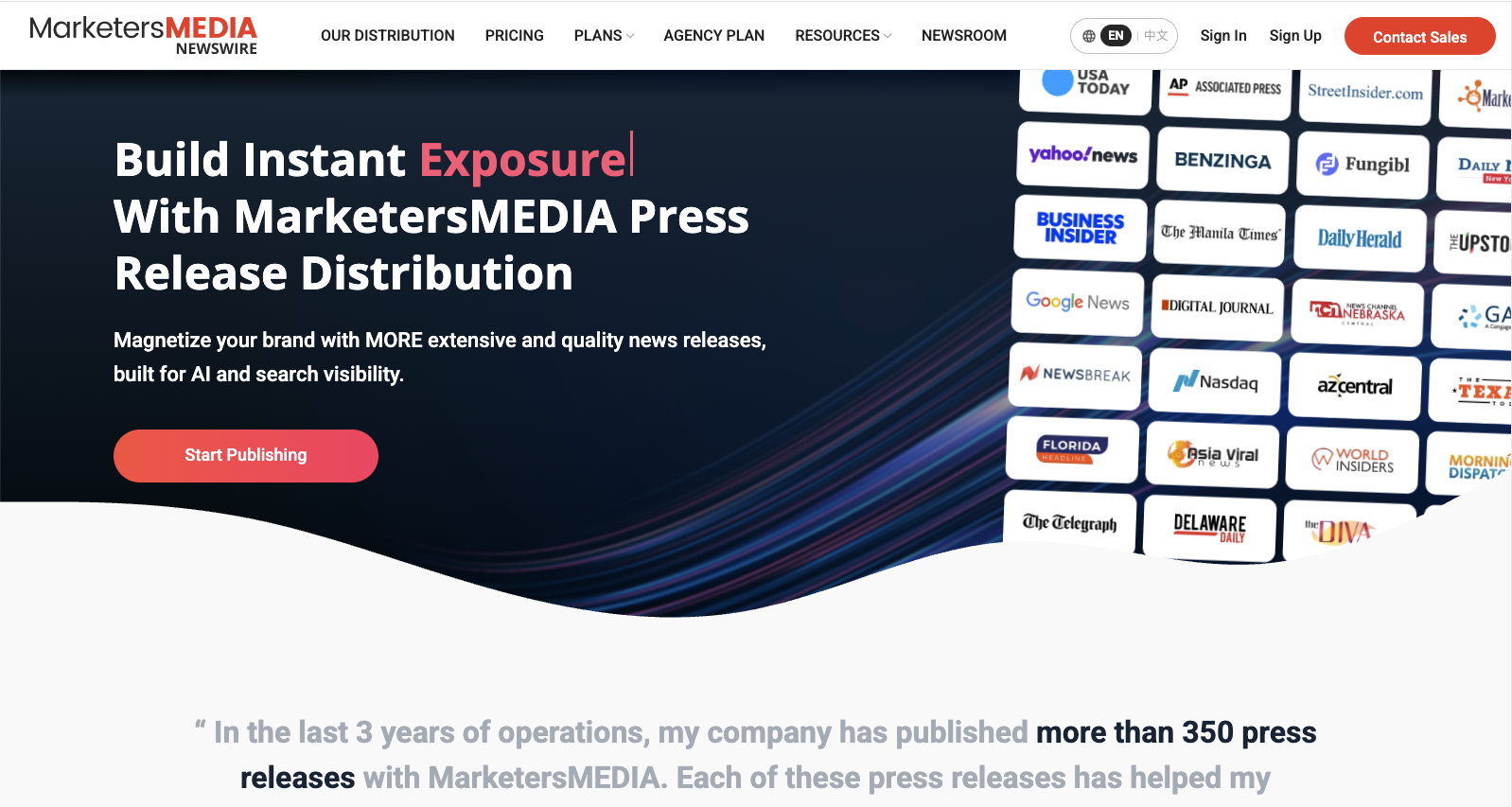
Every service in this guide says something about AI. Nine of them say it in marketing copy. MarketersMEDIA is the only one that ran a test, counted what came back, and published how it was done.
Every plan includes the permanent newsroom placement, Google News inclusion, same-day distribution, scheduled releases, assisted editorial review, and a placement report. The higher tiers add outlet reach and white-label reporting that agencies can send to clients without rebuilding it.
What the audit measured. Across hundreds of releases distributed between, tested using off-brand queries that never named the issuing company, 33.8% were cited through the permanent MarketersMEDIA newsroom page. Counting syndicated publisher destinations and deduplicating at the release level, coverage approached 50%.
These are release-level coverage figures. They measure whether a distributed release appeared at least once across the network. They are not answer citation rates, which would track how often a destination shows up in AI answers. The two measure different things and are not comparable. Because a single release can be cited through the newsroom copy, a syndicated partner, or both, destination rates cannot be added together.
Why it takes first place. At $189 this is the cheapest release in the guide that comes with human editorial review and a permanent indexable page. Three of the four services scoring closest behind it will not quote a price until you talk to sales. If your goal is to be findable by an AI system rather than to appear on a terminal, you are paying a quarter of the money for the only measured result on this page.
Watch for. This is one network’s audit, not a controlled test against nine competitors. There is no public live citation tracker. Check the higher-tier outlet lists against the specific publications you need before upgrading.
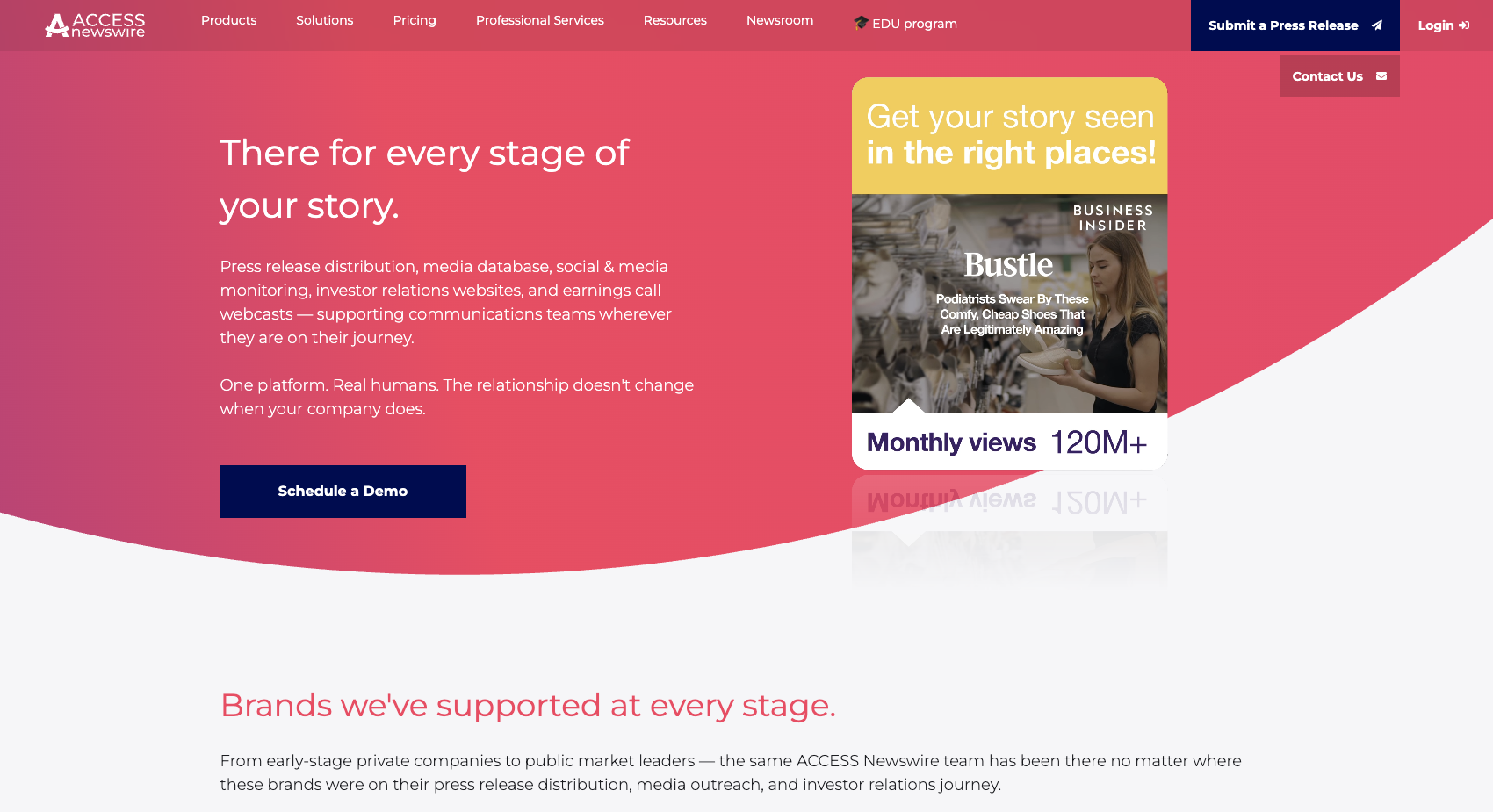
Pay-as-you-go plans run from $475 for Budget to $1,205 for US Premium. Every tier includes unlimited words, links, graphics, and multimedia, plus an ACCESS Insights and Analytics report. The company says that report monitors whether a release is referenced by systems including ChatGPT, Perplexity, and Google AI Overviews, alongside pickup and sentiment data.
The tier details matter. Budget covers major online and broadcast destinations, but AP News, Yahoo Finance, and broker terminals are reserved for National at $865. Business Insider and specialty circuits need US Premium.
Why it earns a place. Citation monitoring is more useful than a generic claim that a release is AI ready. Unlimited media and word count also make the total cost easier to predict.
Watch for. The reporting method is described by the vendor, not validated in a public controlled test. Compare the National tier, not just Budget, if premium endpoints matter.
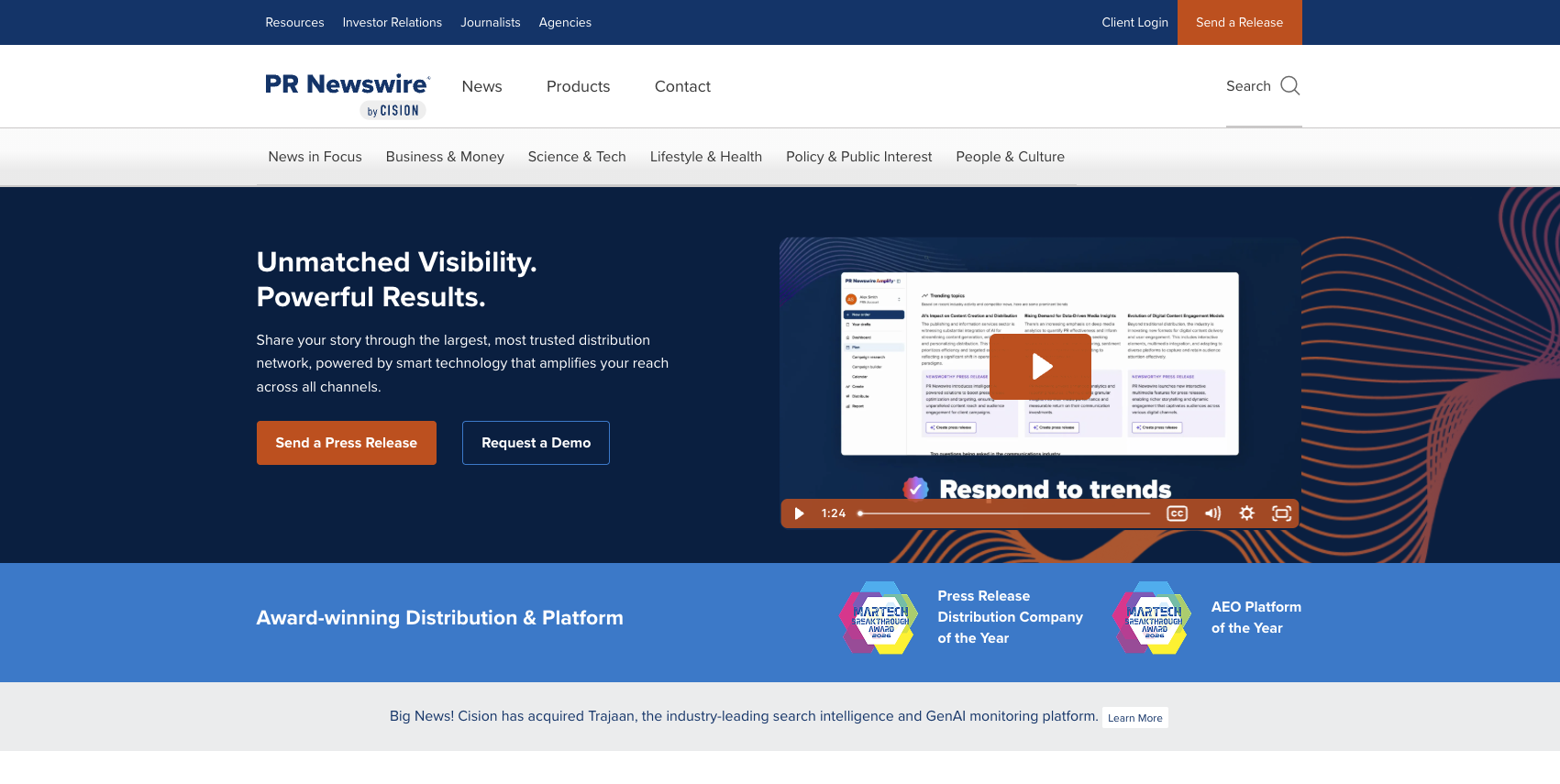
It supports distribution across more than 170 countries and 40 languages. Targeting narrows by geography, industry, vertical, beat, and audience. PR Newswire says its network distributes content to search engines and AI-powered discovery platforms.
Its advantage for AI visibility is indirect but real. Muck Rack found journalistic sources make up a much larger share of AI citations than press releases do. A network that reaches the right journalists creates two paths: citation of the release itself, and independent reporting that may become the more authoritative source.
Why it earns a place. Mature global targeting and a wide media footprint. For a major corporate announcement, that reach can justify the premium.
Watch for. Pricing needs a quote and climbs with scope. Current PR Newswire pages publish different network totals, so we do not rely on any single outlet count. No AI-specific customer citation tracking was documented on the distribution page we reviewed.
The company says it distributes to more than 92,000 media outlets across more than 160 countries. Releases include rich formatting, linked logos, financial tables, expert editorial review, and detailed reporting. NewsTrak reports views, clicks, and the sites hosting the release.
The public starting price is $475 for up to 400 words on a US domestic local circuit. National, international, longer, and multimedia-heavy releases cost more, so do not compare that number against a full national package elsewhere.
Why it earns a place. Trusted financial and newsroom distribution creates a strong source footprint for time-sensitive company facts. The editorial and security processes are worth the money when a factual error would be expensive.
Watch for. Its analytics page documents conventional reach and clicks, not AI citation monitoring. Treat its AI value as strong source availability rather than a measurable citation promise.
The service says it reaches 158 countries in 35 local languages and offers more than 1,000 newslines for geographic, industry, and media targeting. Its platform promotes distribution to search engines and AI tools including ChatGPT, Perplexity, and Gemini.
The most relevant feature here is the SOAR framework: Structure, Originality, Authority, Recency. Those principles line up with what a good release should do regardless of any proprietary AI product. The announcement needs machine-readable facts, original information, a credible source, and a clear date.
Why it earns a place. It joins established global distribution with an AI-specific content workflow rather than bolting AI on as an add-on.
Watch for. No public pricing on the pages we reviewed. Request a quote for the exact countries, languages, word count, multimedia, and financial feeds you need. No comparable customer citation rate is published.
Premium distribution costs $299 per release. The $399 Gold tier adds AIWire, which the vendor says indexes content across AI chatbots, plus an AI Visibility Report. Gold also adds more placements and audio distribution.
Press Ranger’s documentation separates citations, indexing, and training crawler access. That distinction is useful and rare. Its methodology also states that some observations are concrete while estimated reach uses a proprietary model based on distribution footprint, release age, and reader behaviour.
Why it earns a place. It tries to close the loop between publishing and monitoring instead of stopping at a list of pickup URLs.
Watch for. The strongest claims, AIWire included, come from the vendor. Some report fields are estimated. No independent citation-lift study was found. Distribution is English only. Ask which metrics are observed, inferred, crawler-based, or prompt-based before treating the report as proof.
A single release costs $149. At the time of review, the Pro+ package offered five releases plus one free for $499, an effective rate of $83.17. Corporate covered 15 releases for $999. Limits and targeting expand with the plan, from 700 words and one country target on Basic to 2,500 words and two country targets on Corporate.
EIN says all packages distribute to search engines and AI/LLM platforms, alongside its own network, major aggregators, and relevant media destinations.
Why it earns a place. Transparent bulk pricing makes a sustained news programme possible without an enterprise contract.
Watch for. AI ingestion claims are not a citation guarantee. Verify the outlet list in your specific package and confirm whether bonus credits apply before working out total campaign cost. For a high-stakes announcement where authority matters most, there are better options higher up this list.
The $399 Buzz Builder package includes a 400-word release, one industry target, two images, and custom national distribution through Cision PR Newswire. The $499 Newsmaker package expands word count and targeting. The $699 PR Pro tier adds a direct-to-journalist email send.
This works when you want help choosing a package and preparing the release, but do not need a direct enterprise relationship with PR Newswire.
Why it earns a place. An established distribution backbone with service and journalist outreach at published prices.
Watch for. eReleases is a reseller and service layer, not a separate wire network. No AI-specific citation reporting documented. Word counts, extra targets, writing, and some multimedia raise the final cost.
The $399 Starter plan publishes to Digital Journal and online media. The $659 Basic plan adds AP News. The $965 Feature tier adds Yahoo, Nexstar, and other major destinations. Plans include unlimited words and images, which makes costs predictable for detailed announcements.
Newswire also offers media databases, outreach, monitoring, and managed communication services beyond individual releases.
Why it earns a place. Higher tiers provide recognizable online endpoints and a practical bridge between self-service distribution and a broader PR workflow.
Watch for. The Starter footprint is much narrower than Basic or Feature. The pages we reviewed emphasize search visibility and conventional reporting rather than AI citation measurement. Do not compare the $399 plan against a competitor’s premium national tier as though they buy the same thing.
Its site documents distribution to more than 500 media and financial destinations spanning international news, business, search, and market-information sites. The service provides editorial review, targeted distribution, and a report with live placement links.
For AI visibility, EdgeNewswire says releases are indexed in Google News, Bing News, and major LLMs. That creates a potential discovery path, particularly when the announcement contains clear corporate facts, dates, financial information, or original data.
Why it earns a place. Its mix of media sites, financial platforms, search visibility, and permanent release records supports both human discovery and machine retrieval.
Watch for. No public pricing on the page we reviewed. The guaranteed indexing statement is a vendor claim and we found no public method for validating LLM indexing or direct citations. It ranks last here on pricing transparency and measurement evidence, on the same criteria applied to everyone else. Ask for a current distribution list, a sample report, and an exact definition of each AI metric before buying.
Vendors now use phrases such as AI ready, LLM indexed, AI visible, and ingested by AI. They are not interchangeable.
A practical measurement ladder looks like this.
The last step is the business outcome. Fifty crawler visits are worth less than one accurate citation in a question a buyer actually asks.
Distribution cannot rescue a weak announcement. The release has to make a specific fact easy to retrieve and verify.
Announce a real change, disclose a useful number, or publish a method that adds to the public record. Rewording a sales page gives an AI system no reason to cite anything.
Name the source, unit, population, geography, and data period for each important statistic. Link to the underlying report. Separate observed results from forecasts and opinions.
Use a factual headline, a concise summary, descriptive subheadings, a clear date, consistent company and product names, and an informative boilerplate. Put the key fact in text, not only in an image or a PDF. See our guide to [INTERNAL LINK: press release SEO] for the full checklist.
Ten relevant trade, local, or financial publications beat hundreds of unrelated pickup pages. Match the circuit to the people and machines likely to research the topic.
Wire syndication repeats your text. Earned reporting adds verification, context, criticism, and independent authority. With journalistic sources at roughly a quarter of citations in Muck Rack’s sample, distribution should support journalist outreach, not replace it.
Track a stable set of questions across the AI surfaces your audience uses. Store the model, date, market, answer, mentioned brands, and cited URLs. Repeat the run, because source selection changes. Our [INTERNAL LINK: prompt tracking methodology] walks through the setup.
First place is not automatically the right purchase.
Two more services suit narrower jobs. PRWeb is a lower-cost web visibility option, though its $120 Basic plan does not include the 1,200+ website syndication listed for the $245 Standard plan. For Canadian public-company disclosure, TMX Newsfile is worth a specialist look because of its financial-distribution workflow and its 2026 work on machine-readable disclosure.
Yes. Muck Rack’s December 2025 results put press releases at about 6% of observed citations, with three major wire domains accounting for 1%. That shows citation happens. It does not show any service can guarantee it.
Not necessarily. Publisher relevance, accessibility, recency, source authority, and the originality of the claim all matter. Several hundred duplicate copies can still lead a system to pick one canonical source, or none.
No. Indexing makes retrieval possible. The system still decides whether the page is relevant, credible, fresh, and useful for the prompt. Ask vendors whether their metric means a crawler visit, index inclusion, a brand mention, or a linked citation.
Yes. You need an authoritative version with stable facts, supporting material, contact information, and corrections when necessary. The wire expands distribution. The newsroom preserves the official record.
It may generate leads, but syndication is not a journalist reporting your story. Pair important launches with a relevant media list, tailored pitches, and evidence reporters can verify.
For 2026, MarketersMEDIA leads this comparison on the criteria we published: the lowest price in the guide for a release with editorial review and a permanent indexable page, and the only measured citation result rather than a marketing claim. ACCESS Newswire is the alternative when monitoring matters more than price. PR Newswire remains the premium choice for reach.
The larger point outlasts the order. Choose the service that puts a real announcement in front of the right sources, makes the facts easy for machines and people to verify, and gives you evidence of what happened afterwards. AI citation is an outcome to be measured. It should never be assumed from the size of a syndication list.
Updated: 3 September 2026


Subscribe and receive exclusive insider tips and tricks on SEO.
Delivered to you right from the industry’s best SEO team.
Copyright © 2026 SEOPressor. All Rights Reserved.
Powered by Semantics BigData Analytics (SBDA).

