
AEO vs. GEO vs. SEO: How to Choose Your Next Move
Understand AEO, GEO, and SEO, diagnose your discovery gaps, and choose practical next steps using a decision matrix and a worked example.


SEO improves how people discover your pages in search. AEO focuses on answering the questions those people ask. GEO focuses on how your information and brand appear in generated answers. The labels overlap. The useful distinction is the problem each helps you diagnose, not a promise that you can control an AI engine.
If your team is debating which acronym deserves the budget, start with a more concrete question: where does a qualified buyer lose the information needed to choose you?
This guide gives you a working definition of each term, what Google officially says about AEO and GEO, the crawler controls that differ between AI engines, the first-party reports you can use to measure results, and a decision matrix for allocating effort without creating three competing content programs.
What do SEO, AEO, and GEO mean in practice?
Search engine optimization covers discovery, relevance, usability, and the technical foundations that let search engines understand your pages. A page can attract relevant search visits yet still leave the buyer’s question unanswered.
Answer engine optimization is a useful name for improving that answer: making the information accurate, complete enough for the decision, and easy to find. In everyday usage, AEO may include traditional answer features as well as conversational search.
Generative engine optimization is usually used for work aimed at visibility in AI-generated responses: accurate mentions, supporting citations, and representation in product or service discussions. These are working industry definitions, not separate certifications or standardized ranking systems.
| Lens | Useful question | Typical work | Evidence to inspect |
|---|---|---|---|
| SEO | Can the right person find this page? | Indexability, site structure, intent alignment | Indexed URLs, search impressions, relevant visits |
| AEO | Does the page resolve the actual question? | Direct answers, examples, conditions, supporting facts | Task completion, fewer unresolved questions, answer accuracy |
| GEO | How does a generated answer represent the business? | Question sampling, citation review, correcting evidence gaps | Saved responses, cited URLs, accurate brand descriptions |
A comparison page may serve all three purposes. You do not need three versions of it with different keywords scattered through each.
If your team has already chosen the buyer questions that matter but lacks the capacity to work through them, AEOFAST offers a managed AEO service built around a selected set of questions. Whether you use a service, software, or a spreadsheet, the rest of this guide gives you the criteria to judge the work.
Where the terms came from
AEO is the older label. Before generative answers were common, it was mostly discussed in connection with featured snippets, “People also ask” boxes, and voice assistants that read a single answer aloud. The goal was the same as today: give the clearest, most reliable answer to a specific question.
GEO has a more precise origin. In November 2023, researchers from Princeton University, IIT Delhi, and two independent researchers published GEO: Generative Engine Optimization, which named the practice and introduced GEO-bench, a benchmark of 10,000 queries across many domains. The paper was accepted at KDD 2024, a major data-mining conference.
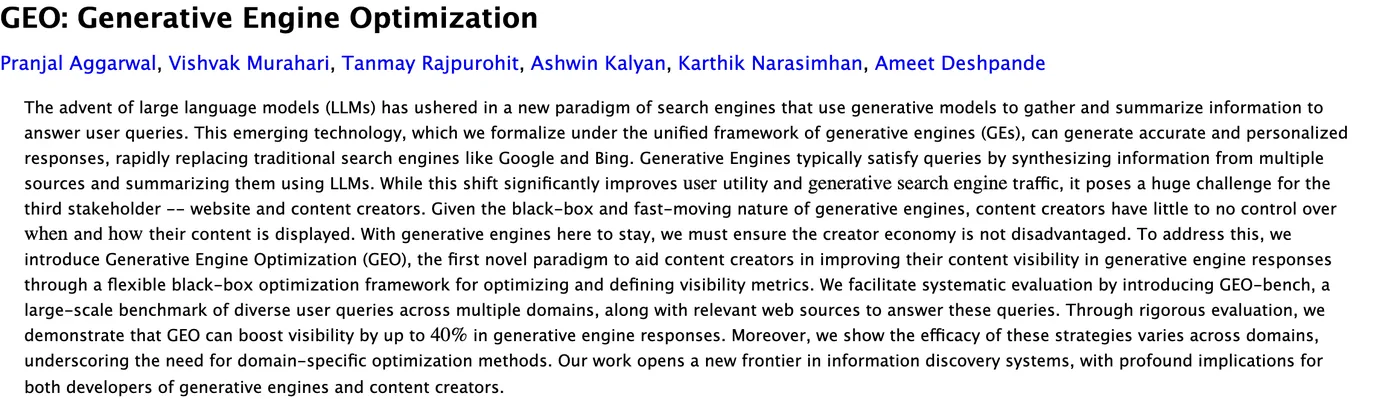
Two of its findings are worth knowing before anyone sells you a GEO tactic:
- Verifiable substance helped. Adding citations, quotations from relevant sources, and statistics improved a source’s visibility by up to 40% in the researchers’ benchmark, and by up to 37% in a test on Perplexity.
- Old SEO tricks did not. Keyword stuffing offered little to no improvement, and in the Perplexity test it performed about 10% worse than the unmodified page.
Treat these as directional evidence, not a formula. The experiments used specific engines, prompts, and dates, and the authors themselves found that effective strategies varied by domain. The durable lesson is that evidence a reader can check tends to be more useful to a generative answer than repeated phrasing.
Does GEO replace SEO?
For Google Search, the answer is no. Google’s guide to optimizing for generative AI search addresses the acronyms directly: “From Google Search’s perspective, optimizing for generative AI search is optimizing for the search experience, and thus still SEO.” Its AI features documentation adds that there are no additional requirements to appear in AI Overviews or AI Mode.
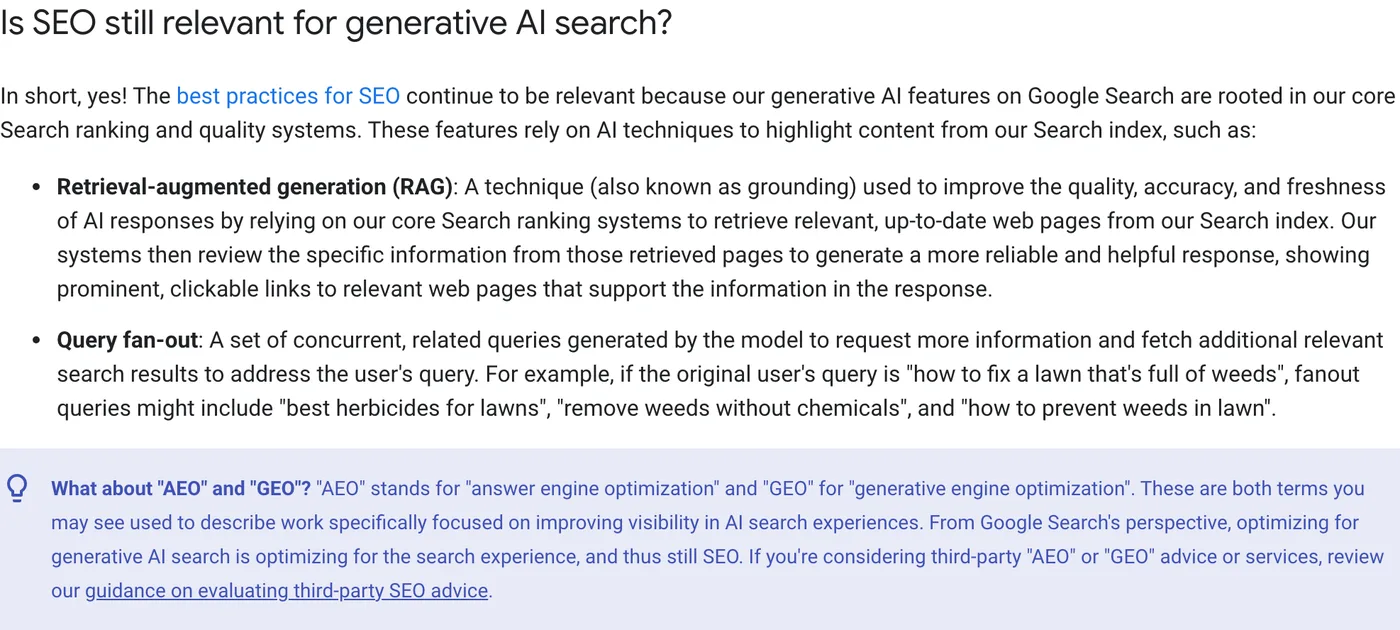
The reason is mechanical. Google describes two techniques behind AI Overviews and AI Mode:
- Retrieval-augmented generation (grounding): core Search ranking systems retrieve relevant pages from the Search index, and the response links to the pages that support it.
- Query fan-out: the model issues several related searches to cover subtopics. Google’s example is a question about a weedy lawn that fans out into searches about herbicides, chemical-free removal, and prevention.
Both techniques start from the index. To be eligible as a supporting link, a page must be indexed and eligible to show a snippet. Since 31 August 2026, every site has also had a Search generative AI control in Search Console. Inclusion is the default, but a site that has been switched to “exclude” will not appear in these features at all, so check that setting before you diagnose anything else.
Google’s guide also lists popular “AEO/GEO hacks” that you can ignore for Google Search:
- llms.txt and other special files or markup. Google Search does not use them. They neither help nor harm your Google visibility, although other services may read them.
- Chunking content into tiny pieces. Google’s systems can find the relevant part of a longer page; there is no ideal page length.
- Rewriting content just for AI. The systems understand synonyms, so you do not need to cover every long-tail phrasing.
- Seeking inauthentic mentions. Spam systems are designed to discount them, and generative features depend on those systems.
- Overfocusing on structured data. It is not required for generative features, though it remains useful for rich results.
The practical implication is sequencing. A content team should not spend a week rewriting headings while its best pages return errors, point their canonical tags at another URL, or bury the useful answer behind a broken interface.
Likewise, technical eligibility is not a guarantee of selection. A working page can still be irrelevant to the question. An excellent answer can also be absent from one particular generated response. Treat inclusion as an observed outcome, not an entitlement.
Google is one engine: access rules differ by platform
Google’s statement covers Google Search. ChatGPT, Perplexity, and Microsoft Copilot are separate systems with their own crawlers and reports, and this is where GEO genuinely adds work that classic SEO checklists miss.
| Platform | Controls whether you can appear in answers | Separate control for model training | First-party measurement |
|---|---|---|---|
| Google AI Overviews and AI Mode | Googlebot access, snippet controls, and the Search generative AI control in Search Console | Google-Extended (not a Search opt-out) | Generative AI performance report in Search Console |
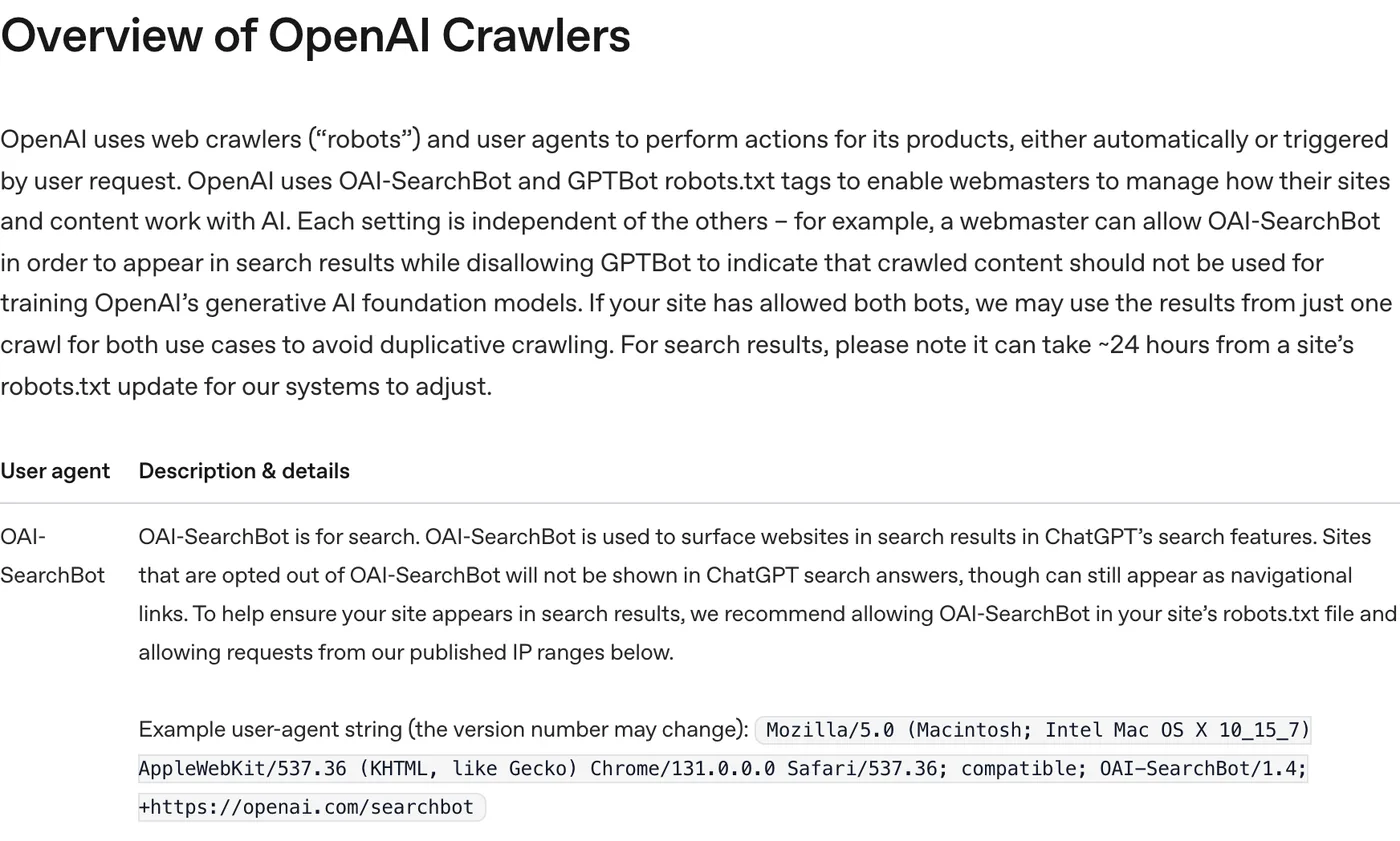
| ChatGPT search | OAI-SearchBot | GPTBot | Referral visits tagged utm_source=chatgpt.com |
| Perplexity | PerplexityBot | Perplexity says PerplexityBot is not used for foundation-model training | Referral visits in your analytics |
| Microsoft Copilot and Bing AI summaries | Bing indexing, managed in Bing Webmaster Tools | Managed separately by Microsoft | AI Performance report in Bing Webmaster Tools |
Three access mistakes come up repeatedly in audits:
- Blocking the wrong bot. A site that blocks GPTBot to limit training can still appear in ChatGPT search. A site that blocks OAI-SearchBot will not be shown in ChatGPT search answers, apart from possible navigational links. Decide on search visibility and training use separately.
- Forgetting the firewall. robots.txt can allow a crawler while a CDN, firewall, or bot-protection rule still blocks it. Google’s guidance explicitly mentions CDN and hosting infrastructure, and Perplexity publishes firewall instructions for this reason.
- Assuming robots.txt covers everything. User-initiated fetchers, such as ChatGPT-User and Perplexity-User, act on behalf of a person asking a question, and their providers say robots.txt rules may not apply to them.
OpenAI and Perplexity both say robots.txt changes can take about 24 hours to take effect in their search systems, so record the date of any change before comparing results.
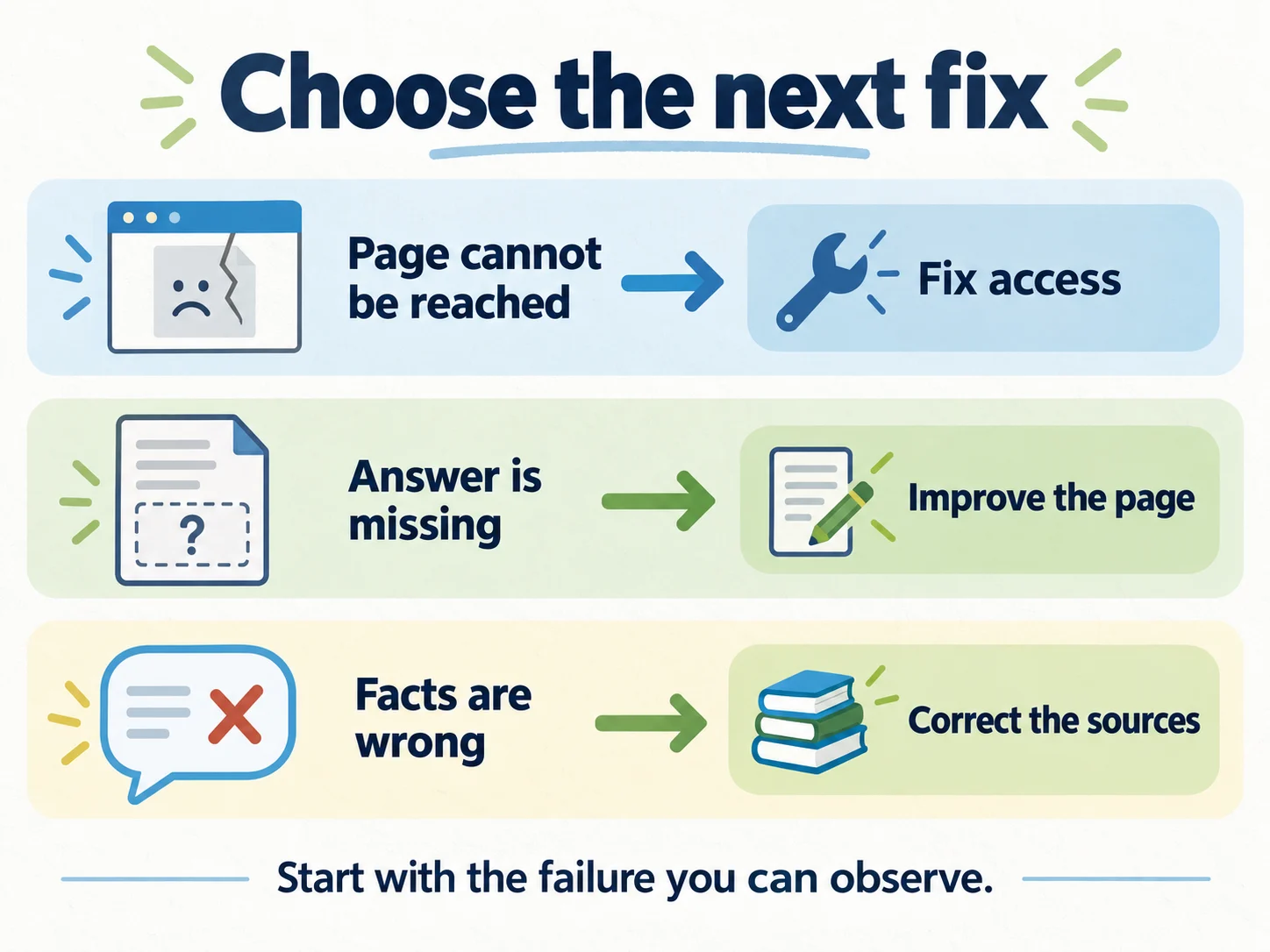
Choose the work by the failure you can observe
Use the following matrix in a planning meeting. Bring an actual page and an actual buyer question; do not score the whole website from memory.
| Observed problem | First action | Avoid this detour |
|---|---|---|
| Important page is unavailable or not indexable | Diagnose access, indexing, and canonical signals | Producing more versions of the same page |
| Search visits arrive but buyers still ask basic questions | Add missing terms, examples, limitations, and next steps | Adding a generic FAQ unrelated to the decision |
| AI answers describe an old feature or wrong service area | Correct the authoritative source and conflicting public facts | Repeating the new claim across low-quality pages |
| Competitors appear for relevant questions | Examine which sources support those answers | Assuming every competitor mention was purchased |
| Reports show mentions but no commercial impact | Connect observations to referrals and qualified actions | Presenting mention counts as revenue |
| An AI engine never cites the site at all | Check crawler access, firewall rules, and platform opt-out settings | Publishing more content before confirming the engine can read it |
This approach also gives you a stop rule. If a page is already clear and the claimed opportunity has no buyer relevance, move on. Optimization is not an obligation to keep changing copy.
Measure each lens with first-party data
Until recently, GEO measurement depended almost entirely on third-party tools that sample prompts. Google and Microsoft now publish their own reports, which gives you a baseline that does not depend on anyone’s proprietary score.
| Lens | Report or signal | What it tells you | What it cannot tell you |
|---|---|---|---|
| SEO | Search Console Performance report | Clicks and impressions from Google Search; AI feature traffic is included in the Web search type | Whether the visit resolved the buyer’s question |
| GEO (Google) | Search Console Generative AI performance report | Impressions in AI Overviews and AI Mode by page, country, device, and date | What the answer said about you |
| GEO (Microsoft) | Bing Webmaster Tools AI Performance | Total citations, cited pages, and a sample of grounding queries across Copilot and Bing AI summaries | Ranking, authority, or placement within an answer |
| GEO (ChatGPT) | Analytics sessions with utm_source=chatgpt.com |
Visits clicked from ChatGPT answers | Visits where the link was copied without the tag |
| AEO | Support tickets, sales questions, conversions after reading | Whether the page actually answered the question | How often an engine displayed it |
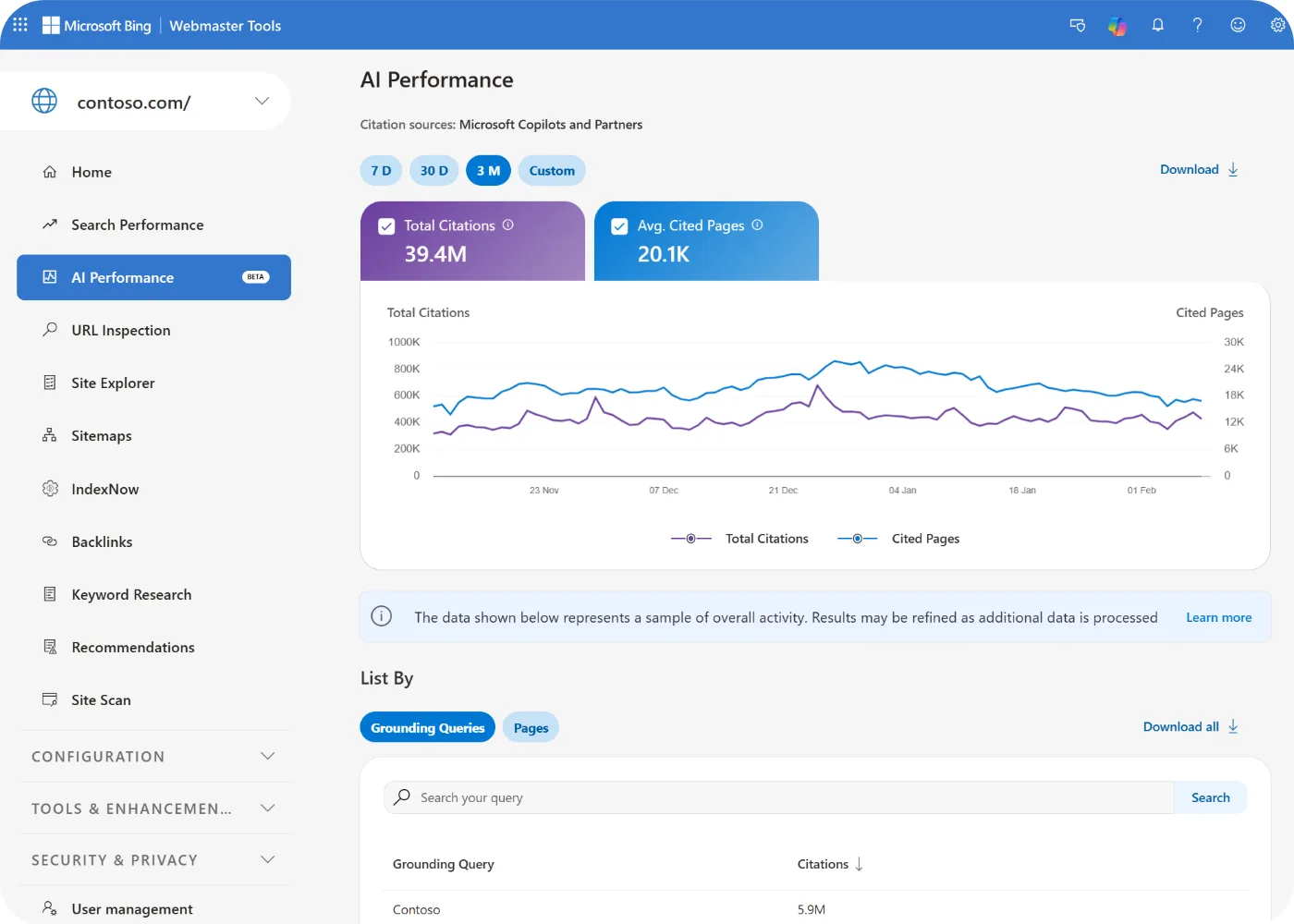
Bing states plainly that its AI Performance report measures citation activity, not rankings, authority, or importance. Apply the same discipline to every report: a citation count is evidence that a page was used as a source, not proof that the answer was accurate or that it produced revenue.
None of these reports shows the full text of a generated answer. Keep a small manual observation log alongside them:
| Date | Engine | Question | Brand mentioned? | Your URL cited? | Description accurate? | Action |
|---|---|---|---|---|---|---|
| Week 1 | Google AI Mode | Best project tool for agencies with freelancers | Yes | No | Partly: lists retired pricing | Update pricing page and old comparison post |
| Week 1 | ChatGPT search | Do freelancers need paid seats in [product]? | No | No | Not applicable | Publish the seat rules on the pricing page |
| Week 5 | ChatGPT search | Do freelancers need paid seats in [product]? | Yes | Yes | Yes | Keep monitoring; no further edits |
The rows above are illustrative. The format matters more than the volume: a fixed question, a dated observation, and a single follow-up action.
Lesser-known details that change decisions
Most AEO and GEO advice repeats the same checklist. The details below come from the platforms’ own documentation and are easy to miss, yet each one can change a decision or explain a confusing result.
- Writing a page for every fan-out query can count as spam. Google warns that creating separate content for each variation of a query, including fan-out queries, primarily to manipulate generative responses violates its scaled content abuse policy. Query fan-out is a reason to make one page complete, not to publish fifty thin ones.
- Two links in one AI answer count as one impression. In the Generative AI performance report, chart data is aggregated by property, so two results from your site in the same AI feature are a single impression. Page-level data is assigned to the canonical URL, and experiments in Search Labs are excluded.
- Image searches have their own filter. The same report separates “Web: text-based” from “Web: multimodal”, which covers Google Lens, Circle to Search, and image uploads. Product and local businesses with strong imagery should check both.
- The Search generative AI control is inherited. A URL-prefix or subdomain property in Search Console follows its parent property’s setting unless someone configures it directly. One forgotten setting at the domain level can exclude an entire blog. Changes typically take effect within one to two days.
- Opting out of AI features is not opting out of training, and the reverse is also true. Google’s control does not affect model training; Google-Extended handles that. Google-Extended, in turn, does not remove you from AI Overviews or AI Mode.
- A blocked page can still appear in ChatGPT as a bare link. OpenAI’s publisher FAQ says that if it learns a disallowed URL from a third-party search provider or other pages, it may show just the link and title. To prevent that, use a
noindexmeta tag, and allow OAI-SearchBot to crawl the page so it can read the tag. - OpenAI may reuse one crawl for two purposes. If you allow both OAI-SearchBot and GPTBot, OpenAI says it may use the results of a single crawl for both search and training to avoid duplicate requests.
- Bing’s grounding queries are not what users typed. Microsoft describes them as the key phrases its AI used when retrieving content. They reveal how the system decomposes a topic, which makes them more useful for spotting missing subtopics than for keyword targeting.
- AI Overviews often do not appear at all. Google says they show only when its systems decide they add something beyond classic results. A missing AI Overview for one query is not, by itself, evidence of a problem with your site.
- Quotations performed best in the real-engine test. In the GEO paper’s Perplexity experiment, adding relevant quotations produced the largest gain on its position-adjusted word count metric, about 22% over the baseline. Attributed expert statements are cheap to add when they are genuine and relevant.
A worked example: a project-management software company
Imagine a fictional company selling project-management software to small agencies. Its team wants visibility for “project management software for agencies with freelance contractors.” This is an illustrative scenario, not a case study or measured customer result.
The first review finds three gaps:
- The feature page says “powerful collaboration” but never explains contractor permissions.
- Pricing does not clarify whether occasional external collaborators need paid seats.
- A migration guide exists, but neither the pricing page nor comparison content links to it.
The useful response is to publish the verified permission rules, add a concrete billing example, and connect the migration guide at the point where a buyer needs it. If the actual product cannot support a requested permission, say so.
Before editing copy, the team also confirms that Googlebot, Bingbot, OAI-SearchBot, and PerplexityBot can reach the pricing and feature pages through the CDN. A firewall rule that challenges unknown bots would make every content improvement invisible to those engines.
Next, the team records a fixed set of relevant questions and checks whether generated answers describe the product accurately. The team saves the answer, source links, date, engine, and context. It does not rewrite the question until the brand finally appears and then call that progress.
The same work improves the buyer’s experience whether a visit comes from conventional search, a colleague, or an AI answer. That is a stronger investment than a page designed only to contain fashionable terms.
Decide whether you need software, a service, or neither
Start manually when you have a small question set and one accountable editor. A spreadsheet, saved response evidence, access to your website, and the free reports from Search Console and Bing Webmaster Tools are enough to establish a baseline.
Software becomes useful when the team needs a repeatable research, production, or reporting workflow across many pages. SurgeGraph is one option to evaluate for AI visibility and content workflows. Test it on your own questions and compare its outputs with the underlying evidence; a proprietary score is not a search engine’s score. Google’s own guidance warns that no third-party tool has access to its internal ranking or AI systems.
For an agency that has chosen commercially relevant questions but lacks delivery capacity, a managed AEO service such as AEOFAST, mentioned earlier, is the third route. The useful procurement question is what work and result evidence you receive for that scope. Outsourcing execution does not remove your responsibility to verify claims about the client.
Avoid buying a tool simply because the acronym on the homepage matches the acronym in the brief. Ask who will use it, what decision it improves, and what you can do with its evidence when a result is disappointing.
A practical allocation for your next planning cycle
Use three work queues rather than three disconnected strategies:
- Remove blockers: errors, missing information, inaccessible pages, contradictory facts, crawler or firewall blocks, and incorrect opt-out settings.
- Improve decision content: comparison criteria, pricing explanations, use cases, limitations, proof, and sourced statistics.
- Measure and learn: fixed questions, citation checks, first-party AI reports, referral quality, and qualified conversions.
Assign each task one owner and one acceptance check. “Improve GEO” is not an acceptance check. “Publish the verified contractor-permissions table and confirm it matches the product” is.
Before creating another page, read SEOPressor’s guide to search intent. Intent is the bridge between a keyword and a useful answer. Our AI visibility audit checklist turns that principle into a repeatable review.
Questions teams commonly ask
Should every article mention AEO or GEO?
No. A buyer comparing contractor permissions needs a good permissions explanation. Use the vocabulary the reader needs, even when the page supports an AI-search strategy behind the scenes.
Can a brand be mentioned without its site being cited?
Yes. Track a brand mention and a link to your domain as separate observations. Also check whether the mention is accurate, relevant, and positive, neutral, or negative.
Do I need an llms.txt file?
Not for Google Search, which ignores it. Some other services may read it, and creating one does no harm, but it should not come before making sure your important pages are accessible, accurate, and indexable.
Should I block AI crawlers?
Treat it as two decisions. Search crawlers such as Googlebot, OAI-SearchBot, and PerplexityBot determine whether you can appear in those answers. Training controls such as GPTBot and Google-Extended govern model training. Blocking a search crawler removes you from that engine’s answers; blocking a training crawler does not.
Is there an official AEO or GEO score?
No. Search engines do not publish one, and Google states that no third-party tool has access to its internal ranking or AI systems. Use first-party reports for the baseline and treat vendor scores as workflow aids.
What should a small team do first?
Choose five important customer questions, inspect the pages that should answer them, and fix the largest factual or access gap. Then establish a repeatable observation process. This is more useful than committing to a large publishing quota before you know what is missing.
Keep reading
More Digital Marketing
How to Run a 30-Day AEO Pilot for an Agency Client
Scope a realistic 30-day AEO pilot with a fixed question set, baseline evidence, deliverables, ownership, and a decision framework for the next…

Local AEO: Help AI Answers Describe Your Business Accurately
Build a local AEO workflow around accurate business facts, service-area evidence, location-based question testing, and separate Maps and AI reporting.

How to Measure AI Search Visibility Without Vanity Metrics
Measure AI mentions, citations, referral visits, and qualified leads with clear formulas, fixed denominators, and an honest reporting template.