
Local AEO: Help AI Answers Describe Your Business Accurately
Build a local AEO workflow around accurate business facts, service-area evidence, location-based question testing, and separate Maps and AI reporting.


Local AEO is the work of making a business easier to discover and accurately describe in AI-generated answers to location-specific questions. A useful program starts with verified business facts and real customer decisions, then checks what different answer systems actually say.
It overlaps with local SEO, but the measurements are different. A Google Maps position, an AI mention, a link in an answer, and a booked appointment are four separate observations. Combining them into one unexplained score makes it harder to know what to fix.
This guide uses a fictional appliance-repair company to show how to build a practical local AEO workflow. The examples are planning illustrations, not a customer case study.
If you would rather hand the question work to specialists, a managed AEO service such as AEOFAST is an option to evaluate for a defined set of commercial questions. Whoever does the work needs the verified fact register described below, and should be able to show how each answer was documented and how a correct mention is distinguished from an unsupported recommendation.
Begin with the facts a customer needs before calling
Imagine a company that repairs washing machines in three districts. Its website says it offers weekend appointments. A directory says it is closed on Saturdays. An old service page lists a brand it no longer repairs.
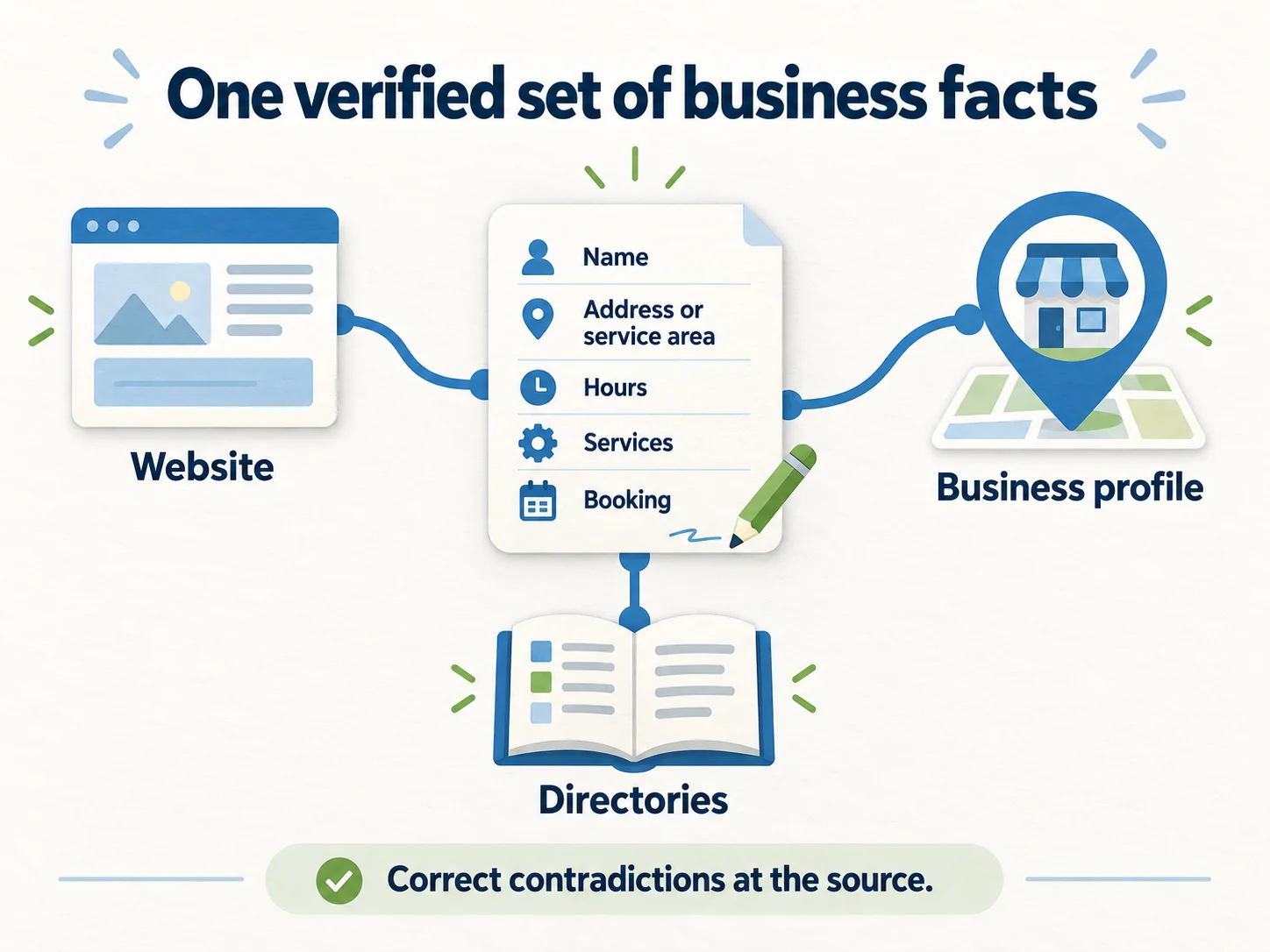
A new blog post about “the best appliance repair” does not resolve those contradictions. Start with a business fact register.
| Fact | Authoritative owner or source | Where to check it |
|---|---|---|
| Public business name | Business owner | Website, Business Profile, directories |
| Customer-facing location | Operations owner | Contact page and location listings |
| Service area | Dispatch team | Service pages and profiles |
| Hours and holiday exceptions | Scheduling owner | Contact page, Business Profile special hours, Apple and Bing listings |
| Services and exclusions | Service manager | Individual service pages |
| Booking process | Customer service | Forms, phone instructions, confirmation pages |
| Pricing conditions | Commercial owner | Call-out fee and estimate explanations |
| Qualifications | Current documentation | About page and relevant service page |
Add a review date and a correction owner. When someone discovers an error, the next action should be obvious.
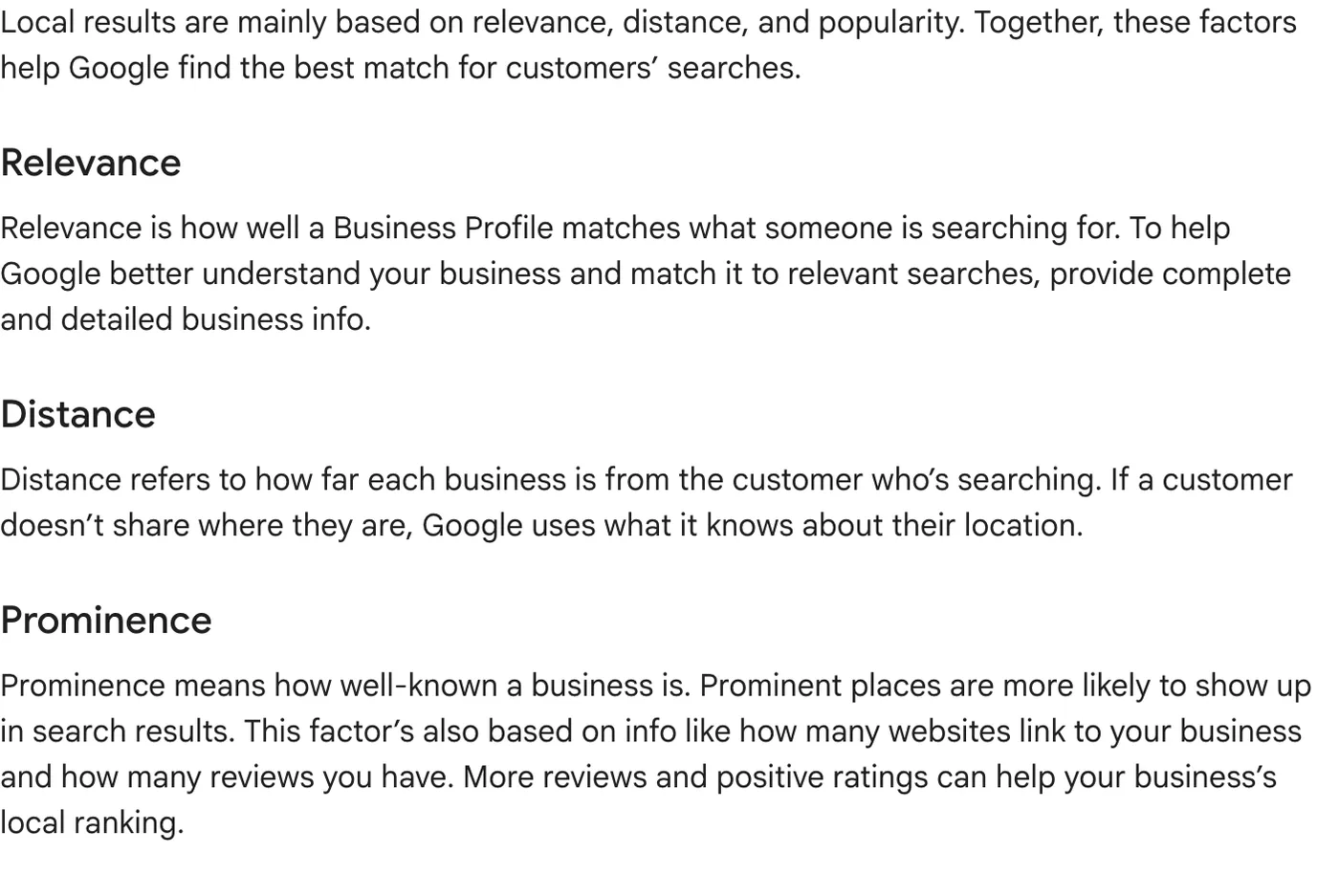
Google’s local ranking guidance emphasizes complete, accurate business information and describes relevance, distance, and prominence. Those are local-search fundamentals; they do not establish a universal ranking formula for every AI answer system.
Keep every listing platform in the register
AI answers about local businesses draw on more than your website. Google’s AI features documentation lists “checking that your Merchant Center and Business Profile information is up-to-date” among its basic recommendations, and its guide to optimizing for generative AI search notes that responses can include information about local businesses, and that Business Profiles can help your services appear in both AI responses and other search results.
| Platform | Where its data appears | Detail worth knowing |
|---|---|---|
| Google Business Profile | Google Search, Maps, and AI features | The business name must match the real-world name; adding keywords to it breaks Google’s guidelines |
| Apple Business (formerly Business Connect) | Apple Maps place cards, Siri, Wallet, and Messages | Apple’s guidance says place-card hours should match the official website whenever possible |
| Bing Places for Business | Bing Maps and Bing local results | Treat it as a separate listing with its own hours and categories to verify |
| Your own website | Every engine that crawls it | It should be the reference that every listing agrees with |
Add a column to the fact register for each platform and record the date you last checked it. One stale listing is enough to give an answer system two conflicting versions of your opening hours.
Google Business Profile rules that prevent wrong answers
Several Business Profile rules matter more for AI answers than their place in the help center suggests:
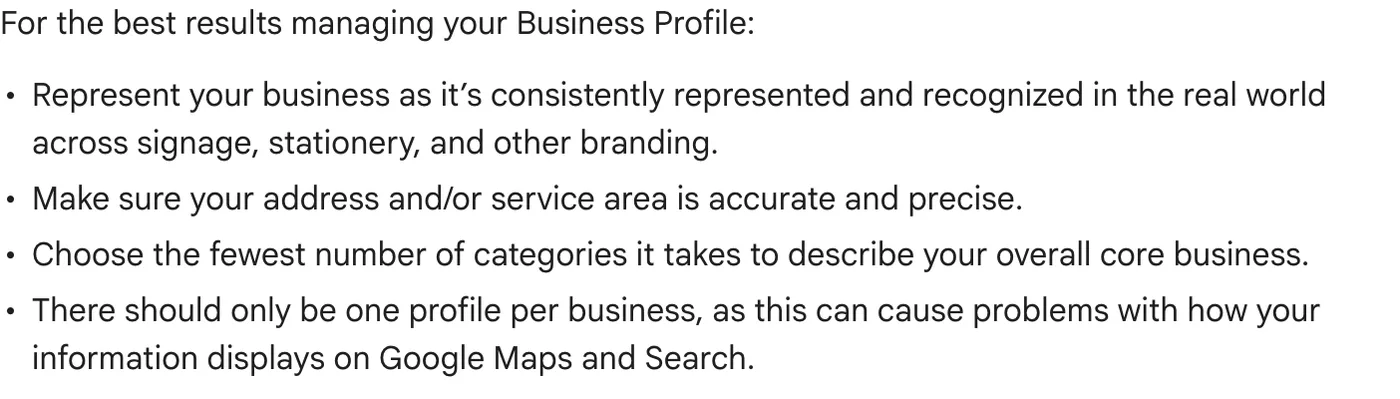
- Name: Google’s representation guidelines require the name used on your storefront, website, and stationery. Extra keywords or locations in the name are a violation, and they also invite AI answers to repeat a name customers never see on the building.
- Address for service-area businesses: if you serve customers at their location and not at your address, Google says to hide the address.
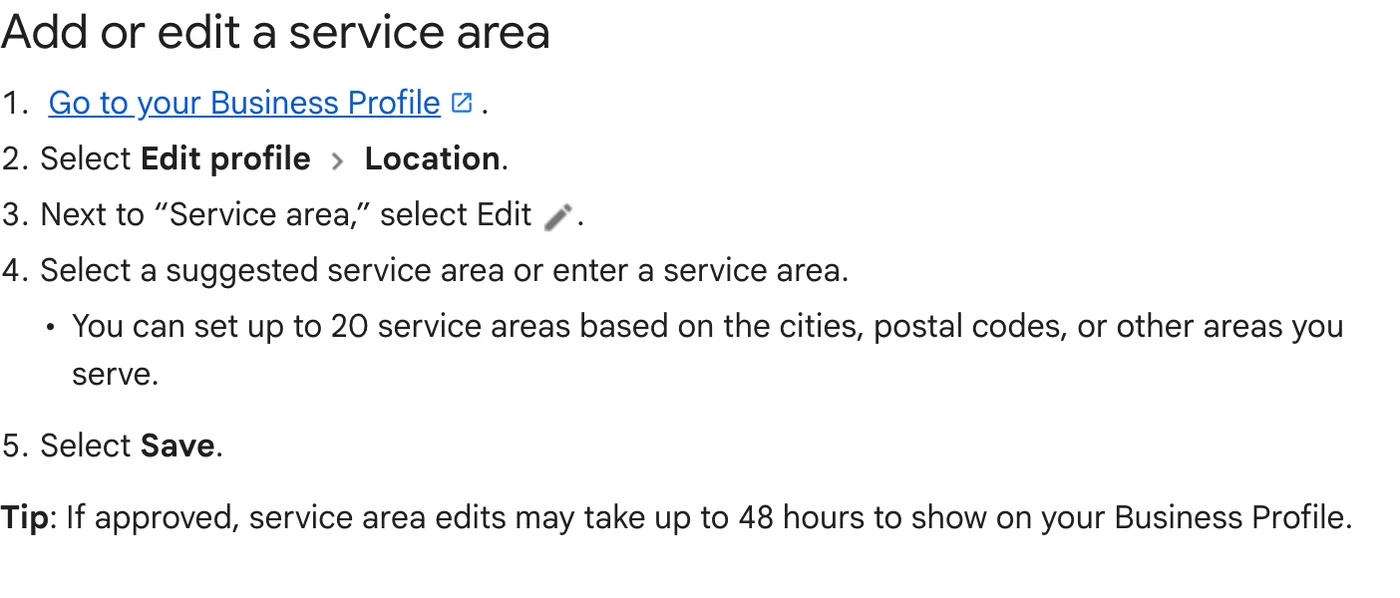
- Service-area limits: Google’s service-area help allows up to 20 service areas and says the overall boundary should not extend beyond about two hours of driving time from where the business is based.
- Legacy radius areas: a service area previously set as a radius around the business can no longer be edited and must be replaced with cities, postal codes, or other named areas.
- Timing: approved service-area edits can take up to 48 hours to appear, so wait before testing whether answers changed.
For retail brands, Google also describes Business Agent, a conversational experience on Google Search that answers shoppers’ questions in the brand’s voice. Google says it uses information from the company’s website in addition to Merchant Center data, and it is rolling out first in the US. If you are eligible, the accuracy of your product pages now directly shapes what a chat on Google says on your behalf.
Build questions around service, place, and constraint
“Appliance repair near me” matters, but it tells you little about the decisions surrounding the appointment. Use three dimensions to build a focused question set:
- Service: washing-machine repair, installation, diagnosis, or maintenance.
- Place: the actual district, town, neighborhood, or service boundary.
- Constraint: weekend availability, supported brands, urgent needs, or price uncertainty.
For example:
| Buyer question | Evidence the business should provide |
|---|---|
| Who repairs washing machines in District A on Saturdays? | Accurate Saturday hours and actual service coverage |
| Does this company repair Brand X front-loading machines? | Current supported equipment and exclusions |
| Is there a call-out fee if I decline the repair? | A clear fee policy with conditions |
| Can I book a visit in District B online? | Working booking route and coverage confirmation |
| What should I prepare before a technician arrives? | Safe, practical appointment instructions |
Keep brand-specific questions separate from discovery questions. “Does Acme Repair open Saturday?” tests whether the answer describes your business correctly. “Which repair companies open Saturday?” tests a different form of visibility.
Do not manufacture hundreds of nearly identical neighborhood pages. A location page should contain information that helps a customer in that location: actual coverage, access instructions, a genuine local team, relevant service details, or a real appointment process.
Make service boundaries explicit
Local answers often become misleading at the edges. A business might serve a town but not every rural address beyond it. It might accept weekend bookings without providing emergency attendance.
Use precise language:
Saturday appointments are available in Districts A and B, subject to booking confirmation. We do not provide a 24-hour emergency service.
That fictional example is more useful than “Fast service across the region.” It gives customers a fact they can act on and prevents a marketing phrase from being mistaken for an operational promise.
Keep the same meaning across the website and business profiles. Wording does not need to be identical everywhere, but the facts should agree. If a third-party page is wrong, request a correction and retain a record of the request; do not assume that changing your own site immediately updates every answer elsewhere.
Test geography without pretending to control it perfectly
A local test record needs more than a question and a screenshot. Save:
- Exact question and any location named in it.
- Engine and search or answer mode.
- Date, language, and available location settings.
- Whether the session was signed in or had prior conversational context.
- Full answer, linked sources, and the business facts stated.
- Any location assumptions you could not verify.
An explicit phrase such as “in District A” is a repeatable part of the prompt. It is not proof that every user physically standing in District A will receive the same response.
Grid My Business offers local geo-grid tracking and AI visibility views. It can fit this location-based research workflow, provided you preserve the scan settings and understand what each report measures. Its Maps observations and AI answer observations should stay distinguishable in your report.
For the traditional local side, see SEOPressor’s guide to local rank tracking.
Use a correction queue before a publishing queue
Prioritize errors by customer impact, not by how easy they are to turn into an article.
| Finding | First action | Verification |
|---|---|---|
| Wrong phone number | Correct owned pages and affected listings | Call the published number and inspect the updated page |
| Incorrect service area | Clarify boundaries in authoritative sources | Review exact locations in subsequent sampled answers |
| Unsupported emergency claim | Remove or correct the source claim | Check the public page and repeat the relevant question |
| Missing fee explanation | Publish an approved fee answer | Have customer service validate the example |
| Accurate answer, business absent | Investigate evidence and discovery gaps | Compare cited sources and relevant competitor facts |
Some fixes improve the customer experience immediately, even before an AI answer changes. Report that benefit honestly. A corrected booking form is a completed operational fix; it is not automatically proof of increased AI visibility.
Choose help according to the actual gap
A team maintaining dozens of locations may need a local reporting and profile workflow. A business with conflicting service claims may need an operations owner and an editor before it needs another dashboard.
If you use a managed AEO service, such as the one mentioned at the start of this guide, give it the verified fact register, target locations, service exclusions, and exact questions.
Do not let a visibility campaign promise services the business cannot deliver. Marketing accuracy is part of the result.
Report visibility and business outcomes separately
A simple monthly report can contain four sections:
- Local search: the same geo-grid keywords and locations, with settings recorded.
- AI answers: mention and citation observations for the fixed question set.
- Accuracy: errors found, authoritative sources corrected, and subsequent checks.
- Commercial outcomes: qualified calls, appointments, and jobs from whatever attribution evidence is available.
A receptionist can ask new customers how they found the business, but self-reported answers are imperfect. Keep that evidence separate from tracked referral sessions. Do not add the two together as if they were automatically distinct customers.
Use the AI measurement guide for denominator and attribution rules.
A manageable first week
Start with one location or one real service area. Verify the ten facts customers most often need, select ten meaningful questions, save a baseline, and fix the three most consequential inconsistencies.
Then publish or improve the page that resolves the largest remaining uncertainty. For the appliance business, that might be a clear service-and-fee page rather than another general advice article.
Repeat the platform check before each public holiday. Holiday hours are among the facts most often wrong in listings, and they are exactly the kind of time-sensitive detail a customer asks an assistant about.
Local AEO is easier to maintain when it reflects how the business actually operates. The test is simple: would a customer who acted on the answer arrive at the right place, at the right time, expecting a service you truly provide?
Questions teams commonly ask
Should we create a page for every town we serve?
Only when each page has genuinely local information, such as coverage details, access instructions, a local team, or a real appointment process. Hundreds of near-identical town pages risk Google’s scaled content abuse policy and rarely answer a customer’s question better than one clear service-area page.
Does structured data replace a Business Profile?
No. LocalBusiness markup can describe your hours and location on your own site, and it should match the visible page. Google still names the Business Profile specifically in its AI features guidance, so keep both accurate.
How long until AI answers reflect a correction?
There is no published timetable. Listing edits can take days to appear, crawlers revisit pages on their own schedules, and some answers rely on third-party sources you do not control. Record the correction date and recheck the same questions after a few weeks rather than daily.
Keep reading
More Digital Marketing
How to Measure AI Search Visibility Without Vanity Metrics
Measure AI mentions, citations, referral visits, and qualified leads with clear formulas, fixed denominators, and an honest reporting template.

AEO vs. GEO vs. SEO: How to Choose Your Next Move
Understand AEO, GEO, and SEO, diagnose your discovery gaps, and choose practical next steps using a decision matrix and a worked example.
Best Press Release Distribution Services for AI Citation in 2026
We compared 10 press release distribution services on price, reach, and the thing nobody else measures: whether the release actually gets cited…